
“Our whole life is nothing but a race towards death, in which no one is allowed to stand still for a little space, or to go somewhat more slowly, but all are driven forwards with an impartial movement, and with equal rapidity.” —St. Augustine, City of God, 13.10
Across social media this time of year, you’ll likely see an unusual Catholic chapel: an ossuary, or “bone churches” in modern parlance. These strange but sacred places often feature skulls lining altars, chandeliers made from femurs, and designs from finger bones. Your average influencer or tour guide will present this as a Catholic Halloween decoration, but it is much more than that. Ossuaries are a place where pilgrims come face to face with the Church’s teachings on memento mori—the ancient practice of remembering and contemplating death.
Roughly translated, memento mori means to “remember [your] death,” and it entails contemplating the inevitability and universality of death in order to enrich life. Thus, memento mori is not a macabre exercise in allowing the reality of death to defeat us, but a contemplation of this undeniable reality so that we may live a good life. As St. Robert Bellarmine said, “A good death depends upon a good life.”
Death may be an inescapable reality, but as Catholics, we know that it does not have the final word. “The last enemy to be destroyed is death,” declares St. Paul (1 Cor. 15:26), which, by His death, Christ has defeated. Because of this victory, our ancestors understood that contemplating the grave wasn’t an exercise in despair, but a preparation for eternal life.
Let’s see how this concept ties into the first ossuary I visited, and perhaps the most famous: the crypt beneath Santa Maria della Concezione dei Cappuccini in Rome, known as the Capuchin Crypt. The church that houses the ossuary had been a dream of the Capuchin Cardinal Antonio Marcello Barberini, a member of a princely family and the brother of Pope Urban VIII. He found land on Via Veneto near his family’s palace and assigned Fra Michele da Bergamo, a Capuchin friar, as the architect for his church, which was to be dedicated to Mary’s Immaculate Conception. Construction wrapped up in 1631, but the friars had one final task: moving their dead to their new church.
While it may seem strange to us today to exhume bodies and move them across town, we need to understand the reality our Christian ancestors faced. A common problem with burial grounds throughout Christendom was that there was only so much room for the dead. Everyone must die, and they must be given a Christian burial, but what do you do when you run out of space? The Capuchins of Rome, along with other churches, came up with the idea of decorating their crypt chapels with the bones of their deceased friars.
Some of the bones in the Capuchin Crypt are kept whole, with skeletal friars in their brown habits looking back at you. Skulls adorn the altars, and even the lamps and passageways are decorated with a variety of human bones. It is a shocking place, one that frightened authors such as Mark Twain and Nathaniel Hawthorne. It also left a permanent mark on my own psyche, but as a Catholic, it was also a spiritual experience I’ll never forget.
I was a student in Rome in 2007, having only received confirmation a few years before. When I visited the Capuchin Crypt, I didn’t even know the words memento mori. As a longtime fan of horror movies and ghost stories, I wanted to visit a strange and spooky place after class one day, and so I made my way to Via Veneto and the Crypt. Instead of that experience, my mind awoke to the wonderful teachings of memento mori.
At the time, you entered the Capuchin Crypt through the church, and I saw two things that changed my perspective: first, a painting of Mary and the saints rescuing souls from purgatory. Second, in a chapel built from skulls stand three skeletons clothed in the brown robes of the Capuchin order. Each skeleton holds an item to represent death and, as if the bones could talk, a sign proclaims in five languages, “What you are now, we once were; what we are now, you shall be.”
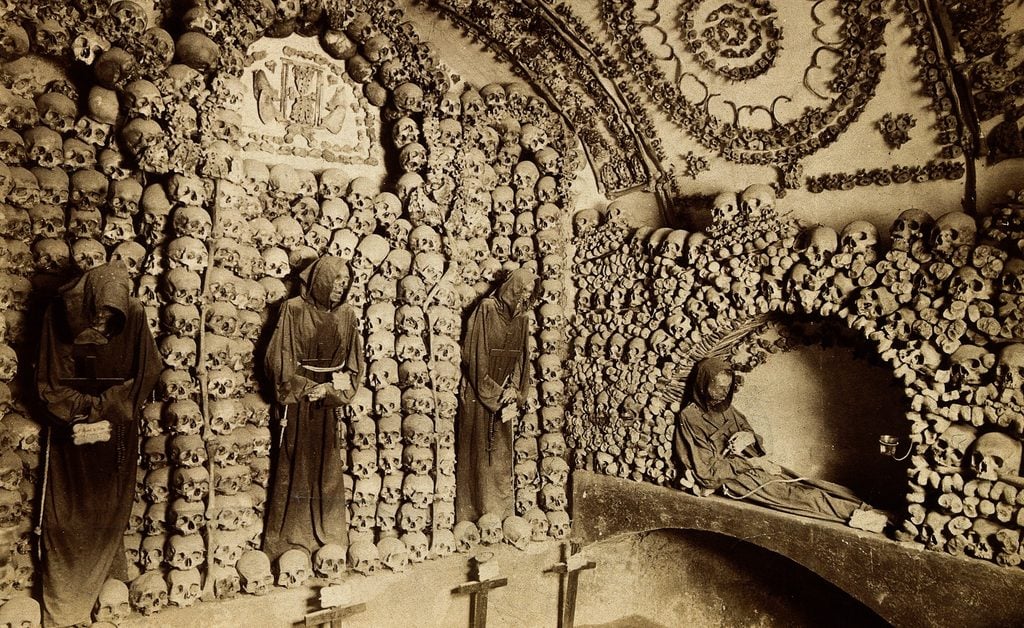
As a new Catholic and student, that sign was a gut-punch of memento mori. In that moment, below the streets of Rome, I had a flash of realization. I suddenly understood a core Catholic teaching: that the dead friars and I were separated by time, language, and culture, but we were united in our faith. I knew that I was going to pray for the deceased friars, but more importantly, they were also praying for me. In that moment, I met my brothers in Christ and understood that the work of our faith continues, even in death.
As I left the Capuchin Crypt, I was thankful for what God taught me through my accidental pilgrimage. It planted a seed for my continued work to understand our Catholic ancestors and also inspired my continued work to pray for the dead. Finally, it also made me understand just how big of a promise it was that one day, maybe long after I’m gone, Christ would return and breathe life into these dry bones, raising the dead from their tombs.
I’ve visited many more ossuaries and crypts, trying to find that spiritual experience I first had in Rome. Each one has a unique story and stands as a reminder of death, judgment, and the promise of Resurrection. While I know not everyone will experience these odd and sacred sites the way I do, I hope you get to see an ossuary and that it will inspire you the same way it inspired me.
“Now, to live well,” St. Robert Bellarmine wrote, “it is necessary, in the first place, that we die to the world before we die in the body.” Rather than just shocking sites, places like the Capuchin Crypt allow us to reflect on St. Robert’s wisdom. Ossuaries give us a chance to viscerally see how death may be inescapable, but they also proclaim the promise of everlasting life in Christ, whose death allows us to proclaim, “O death, where is thy sting?” (1 Cor. 15:55)
Author’s Note: This article includes information found in my book, Weird Catholic Handbook. In it you’ll find more information about ossuaries, as well as other topics like saints who fought monsters, old Catholic ghost stories, spiritual warfare, and confounding miracles. I also highly recommend St. Robert Bellarmine’s The Art of Dying Well if you’d like a primer on memento mori.
Photo by Ahmet Yüksek ✪ on Unsplash

