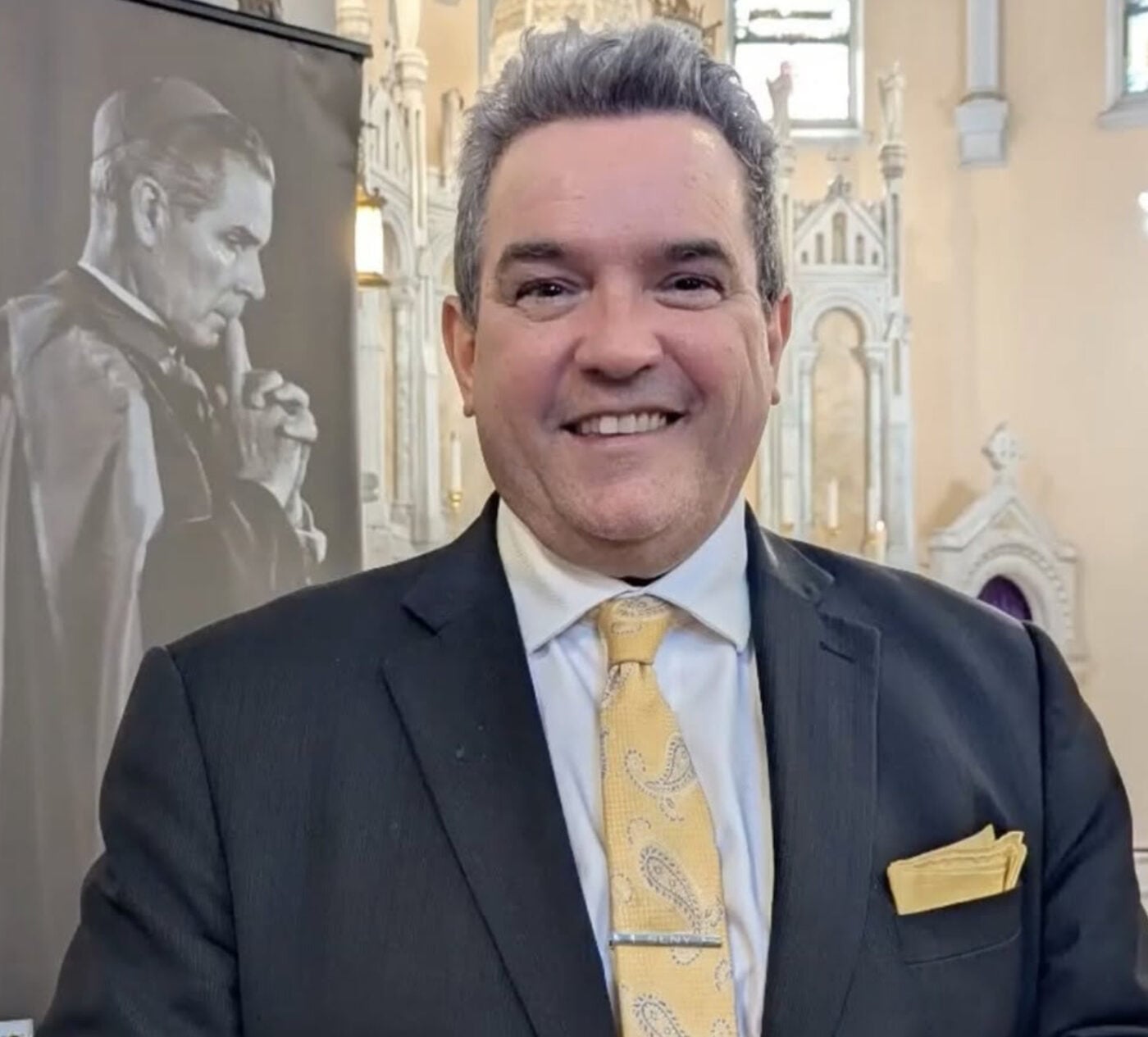
One day a few years ago, I recall watching Fulton Sheen’s last recorded Good Friday address from 1979, which is still available on YouTube. In the presentation, Archbishop Sheen told his audience that this was his fifty-eighth consecutive year of giving this type of reflection about Christ’s Seven Last Words from the Cross.
Being a Scripture scholar, Archbishop Sheen knew full well the power contained in preaching about Christ crucified. With St. Paul, he could say, “For I decided to know nothing among you except Jesus Christ and him crucified” (1 Cor. 2:2).
From the young priest in Peoria, Illinois, to the university professor in Washington, D.C., and to the bishop in New York, Sheen’s messages continued to acquire newer depths and were sure to make a lasting impression on his listeners.
For Fulton Sheen, the Seven Last Words were not merely a subject of study, but the central theme of a lifetime of prayer, providing a bountiful resource for his preaching. He believed that the Cross is not simply an event to be remembered, but a mystery to be entered—one that reveals both the tragedy of sin and the greater triumph of divine mercy. Sheen would refer often to Calvary as “a living school of love.”
The Seven Last Words Explained
Upon reviewing Fulton Sheen’s numerous reflections on the Seven Last Words, which he first presented on The Catholic Hour Radio Show in the 1930s, a pattern began to emerge in the years that followed. At first glance, one might assume that Fulton Sheen might simply repeat the same reflections year after year, like some preachers do, who recycle their homilies. But with Sheen, nothing could be further from the truth.
As I began collecting and republishing his writings, I noticed a remarkable pattern. Each Lent, Sheen would return to the theme of Calvary, while approaching it from a completely different perspective. The Seven Last Words became the foundation upon which he built a new spiritual masterpiece every year.
For example, in 1935, he paired the Seven Last Words with the seven petitions of the Lord’s Prayer, demonstrating how the perfect prayer finds its fullest expression in Christ’s final moments on the Cross. The following year, in his book, Calvary and the Mass, he revealed how every part of the Holy Sacrifice of the Mass is illuminated by the drama unfolding on Calvary. In 1937, he connected the Seven Last Words to the Beatitudes, demonstrating that the Sermon on the Mount reaches its fulfillment on Golgotha.
And this pattern continued. He reflected on the theme of suffering in The Rainbow of Sorrow (1938), the struggle against the seven deadly sins in Victory over Vice (1939), the cultivation of the cardinal and theological virtues in his book, The Seven Virtues (1940), and the profound union of Jesus and His Mother in Seven Words of Jesus and Mary (1945).
What struck me was not merely Sheen’s creativity but his conviction. He viewed every aspect of the Christian life through the lens of the Cross. Whether he was speaking about prayer, the Mass, virtue, suffering, discipleship, or the Blessed Virgin Mary, he always led his audience back to Calvary. For Sheen, the Cross was not one topic among many but the necessary key that unlocked every mystery of the Christian life.
With that discovery, I began to read Fulton Sheen’s works in a totally different light. And more importantly, it changed my perspective of the Cross, not merely as the place where Christ died to make atonement for sins, but rather, I realized that the Cross is the place where the Lord teaches His most powerful sermon about how to live, how to suffer, and above all, how to love.
The Cross or the Crucifix?
When I look at pictures of the saints, I often see them holding a crucifix and gazing at it with great devotion. If you watch enough of Fulton Sheen’s videos, you will notice that many times his hands will touch his pectoral cross almost in a way that he would want our eyes to be drawn to it.
It is interesting to note that throughout his life, Sheen carried several tiny crucifixes in his pocket, and frequently gave them away to others, encouraging them to look upon Our Lord on the Cross. Sheen would encourage everyone to develop this holy habit of keeping a crucifix in their pocket or purse and to place one in every room as a reminder of God’s love for them. In Fulton Sheen’s own bedroom stood a five-foot crucifix at the foot of his bed, so that the first and last face he saw each day was the face of Jesus, giving His life for the salvation of the world.
But why cultivate such devotion to the crucifix?
Sheen answered with words that have lost none of their power:
The Cross is eternal! It cannot be dug up; it cannot be taken down! It is the core of creation! It is the root of all our lesser Calvarys! … It is God who gives us the Cross. And it is the Cross that gives us God.
For Sheen, the Cross has a greater meaning than just being an historical event or a religious symbol. He knew it as the place where every disciple learns the meaning of love: that authentic love always costs something; that true love is sacrificial; that love forgives; love perseveres; and love gives itself away.
Having such deep sentiments for the Crucified Lord, Sheen issued an even more personal challenge:
You want the Cross but not the crucifix. The cross you wear can be a charm, but the crucifix cannot. Somehow, when you see it, you feel involved! A statue of Buddha does not stir you. Put a crucifix on your desk for three days and see what it does to you!
There is a world of difference between wearing a cross as jewelry and gazing upon a crucifix in prayer. One is a reminder of Christianity; the other is an invitation to discipleship. The crucifix confronts us with the One who loved us “to the end’’ (Jn. 13:1) and quietly asks whether we are willing to love in the same way.
The Crucifix Is My Autobiography!
If there is one passage that summarizes Fulton Sheen’s spirituality better than any other, it may be found in his autobiography, Treasure in Clay. Few paragraphs reveal his understanding of the Cross more profoundly than these words:
The life of each and every one of us has been written.
The crucifix is my autobiography.
The blood is the ink.
The nails the pen.
The skin the parchment.
On every line of that body, I can trace my life.
In the crown of thorns, I can read my pride.
In the hands that are dug with nails, I can read avarice and greed.
In the flesh hanging from him like purple rags, I can read my lust.
In feet that are fettered, I can find the times that I ran away and would not let Him follow.
Any sin that you can think of is written there.
It is my conviction that Fulton Sheen viewed this “autobiography” more as a path to redemption rather than as a cause for despair. By meditating on the Cross, he argued that we are called to unite our personal faults to Christ’s sacrifice, transforming our daily struggles into a life of grace.
Perhaps that is why Fulton Sheen, in his sermons, returned to the theme of the Seven Last Words and the Cross year after year. Whether speaking about prayer, the Mass, the Beatitudes, virtue, suffering, or Our Blessed Mother, every road eventually led back to Calvary. There, at the foot of the Cross, Christ reveals the greatest lesson any disciple can ever learn: that love is measured not by what it receives but by what it is willing to give. To stand before the crucifix is to stand in the greatest classroom ever known, where the Divine Teacher continues to instruct every generation in the art of learning to love.
Indeed, that explains why the Crucifix hangs in every Catholic church and has found its place in countless Catholic homes. It is far more than a religious ornament; it is the Master’s throne. Every glance toward the crucified Christ becomes another lesson in forgiveness, humility, sacrifice, perseverance, and mercy. We spend our entire lives learning those lessons, and even then, we have only begun. The greatest education the world can offer may fill our minds, but the Crucifix alone teaches the heart how to love, and that is a lesson for eternity.
Author’s Note: Many of Archbishop Fulton J. Sheen’s classic reflections on the Seven Last Words have been preserved in two anthologies published by Sophia Institute Press: The Cries of Jesus from the Cross and Lord, Teach Us to Pray. Together, these volumes bring together nine of Sheen’s timeless works on Christ’s Passion, originally preached and published between 1933 and 1945.
Readers wishing to continue their journey into the mystery of Calvary may also enjoy my newest book, The Soul of a Disciple: Fulton Sheen’s Meditations on the Cross, the Eucharist, and the Christian Life, which expands upon many of the themes explored in this article.
Editor’s Note: This article is a part of a CE original series, “Cultivating the Soul of a Disciple with Blessed Fulton Sheen,” in celebration of and preparation for Archbishop Sheen’s beatification this month.
Photo by Lorenzo Turroni on Unsplash