
I have written extensively in this forum on the practice of visio divina, and on its benefits for a person’s spiritual life and growth. As the Solemnity of All Saints approaches, a visio divina exercise on Saint Augustine by Philippe de Champaigne offers a wonderful opportunity for any viewer. In the quest for sanctity this painting, and St. Augustine himself, offers a poignant reminder of the transformative work God desires to do in the minds, hearts, and actions of anyone who answers His call with a generous heart.
Meditating on Champaigne’s painting, my eyes are drawn first to Augustine’s face. He is in awe of something. The direction of his gaze helps me know what that thing is. His eyes are locked on the light source at the top-left corner of the painting, which bears the Latin word VERITAS. This reminds me of his diligent, even obsessive, quest for Truth from his late teens onward.
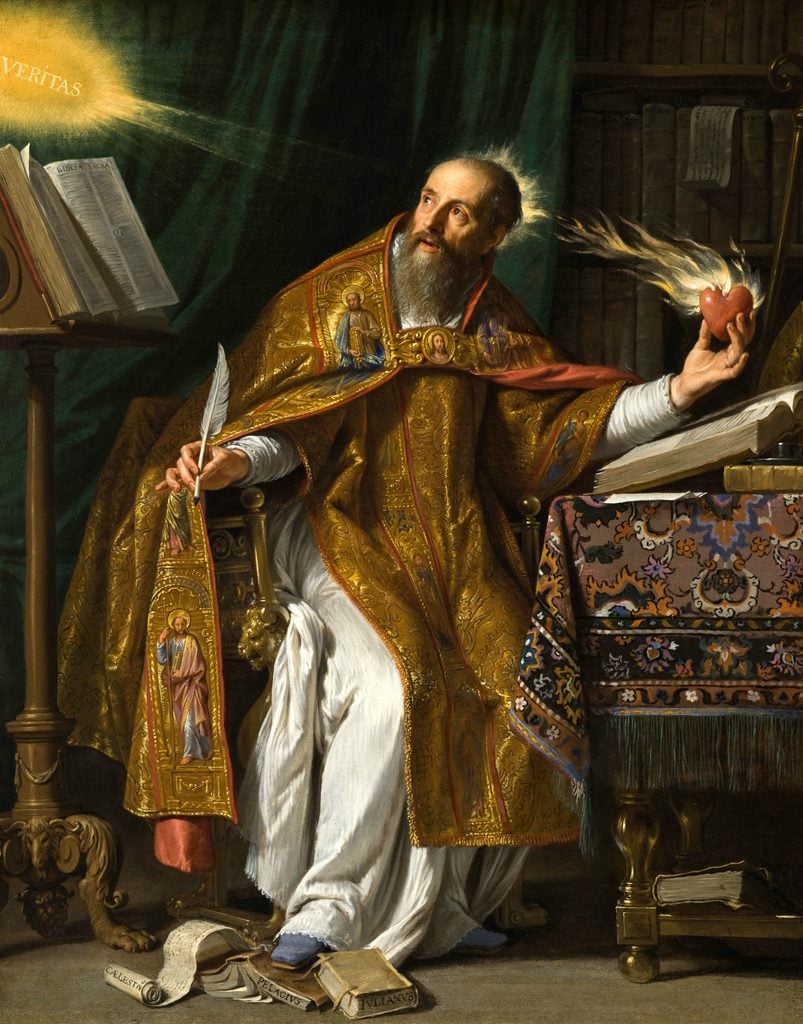
In his spiritual autobiography, Confessions, Augustine recounts a significant transformation in his life. After experiencing the “cauldron of shameful loves” that was ancient Carthage, he writes, “All my vain hopes forthwith became worthless to me, and with incredible ardor of heart I desired undying wisdom” (III.1, 5). The ray of light emanating from Truth enlightens and enflames his intellect, a fact signified by the aura of flame around the back of his head.
The line from the Light Source passes through Augustine’s head—that is, through his intellect—and terminates in a flaming heart. Here, the artist obviously means to capture the image of the restless heart the author mentions at the very outset of Confessions: “…for you have made us for yourself, and our heart is restless until it rests in you” (I.1). Beyond that, the saint recounts the movement of his heart after his initial turn toward Truth: “How I burned, O my God, how I burned with desire to fly away from earthly things and upwards to you” (III.8).
The enflamed head and the enflamed heart seem to be having a mutual effect on each other. This ought to remind us of the mutual effect a person’s intellect and will have in his or her soul. Augustine writes in Confessions of the mutual effect these two powers of the soul have on a person’s psyche. His mind, he explains, knows something, and he even commands himself to do that thing. “The trouble is,” he writes, “that it does not totally will: therefore it does not totally command” (VIII.9).
Later in the same work, the writer draws together the themes of light and flame, dealing with the mind and the heart. “You have blazed forth with light and have shone upon me,” he writes, “and you have put my blindness to flight! …You have touched me, and I have burned for your peace” (X.27). Intellect and will, mutually enflamed, impels a person toward the Divine Source of Light, Love, and Peace.
Pondering these details opens my own conversation with the Lord. How diligently have I sought Truth? From which sources have I sought it? Has the search for truth enflamed and enlightened my mind? Has my heart followed my head? Has my desire for Goodness and Beauty caused me to search more diligently for Truth? Is God’s Peace a desire that burns constantly in my soul?
I also notice the book directly below the Light of Truth. Augustine’s search for Truth orients him toward BIBLIA SACRA. The Bible factors prominently into Augustine’s conversion (see Confessions VIII.12, for example); and it was a source of inspiration for so much of his Christian theology and teaching. The quill pen he holds in his hand might be symbolic of the hundred-plus individual works he penned—books, biblical commentaries, letters, and sermons that totaled some five million words.
In Confessions, he comments that God gifted Holy Writ to humans “since we were too weak to find the truth by pure reason,” and that God I desired it to be a primary source of humans seeking and knowing Him (VI. 5). This is obviously true for Augustine as all of his scholarship, commentary, and preaching was saturated with the words and message of Sacred Scripture. Those facts lead me to ask about my own devotion to Truth and Sacred Scripture. Do I spend time meditating on God’s Word? Even if I will not write nearly as much as Augustine, do I allow the Bible’s light to shine on my daily pursuits, whether they are lofty ideas or basic moral actions?
Augustine’s garments also factor prominently in this scene. The outer garment is a liturgical vestment, likely significant of the fact that Augustine was ordained a priest shortly after his conversion and, eventually, a bishop. Under these vestments, Augustine dons a white garment, legitimately an alb, which signifies the priest’s baptismal purity. Augustine took seriously both his Baptism—which occupied such a central place in Confessions—and his service as a bishop. In Sermon 340, he preached to his flock in Hippo, “For I am a bishop for you, with you I am a Christian.” The remainder of the homily explained the necessity of both parts of the Church—the ordained hierarchy and the laity—assisting each other in answering the call to holiness.
Do I reflect on the grace of my own Baptism? Do I revisit the baptismal ritual, or the teachings on Baptism (found, for example, in the Catechism)? Do I realize that I have been baptized into the common priesthood of the faithful, called to offer sacrifices within my daily life? Do I engage in reverent celebration of the liturgy, even as someone simply sitting in the pews? Does the liturgy inform and inspire my intellect and will, my desire to know what is True and act in ways that are truly Good?
Three other books in the scene gain my attention, all at Augustine’s feet. One is inscribed with “Julianus,” which likely refers to Julian the Apostate, the Roman emperor who rejected his baptismal faith just before Augustine’s birth. In City of God, Augustine describes Julian as “the man whose marvelous gifts were poisoned by his lust for power”; who “fell a victim to a silly and sacrilegious occultism”; who “put his trust in vain oracles” (V.21). The book on which Augustine’s right foot rests bears the name Pelagius, Augustine’s contemporary (born in the same year) who denied original sin and taught that humans could earn their salvation. Beside that second book is a scroll bearing the name Caelestius, who was a disciple of Pelagius. Augustine wrote extensively against the Pelagian heresy; and he recommended that Caelestius be excommunicated at the Council of Carthage in A.D. 411. Each of these prominent figures of his era gave Augustine the opportunity to preach and teach on man’s fallen condition and his need for grace. Because of this general message, and because of his refutation of Pelagius’ heresy, in particular, Augustine is known as the Doctor of Grace.
Ruminating on Augustine’s title—on his humble, yet heroic work—do I recognize the primacy of grace in my life as a Christian disciple? Or, do I continue to carry a disposition that I can earn God’s favor? Do I have a lust for power or control? Do my actions suggest that I can find salvation and fulfillment by any means other than God’s gift?
One final detail near the bottom of the painting warrants attention. The toes of two blue shoes peek out from below the alb. In sacred art, blue is typically associated with wisdom, quietude, and contemplation. It is also traditionally associated with the Blessed Virgin Mary, and the position of Augustine’s foot here very much resembles Mary’s foot crushing the head of the serpent in many depictions of her. Finally, blue also connotes divinity. Tying all these meanings together, I surmise that the artist intends to depict Augustine relying on Divine Grace and, by employing the fruit of years of contemplation, striking an intellectual blow to the serpent’s “head,” Pelagius, who taught that humans could work and earn their salvation.
As I conclude this visio divina exercise, I am inspired to imitate Augustine’s holiness. Like him and all the saints, my Baptism and my participation in the Church’s sacramental life are the chief sources of grace. I pray God will pour out His grace to enlighten my intellect and enflame my will so my soul’s two faculties might operate in mutual combustion. Finally, I pray those graces will guide me, in the mundane settings of my life, toward an energetic and charitable presentation of Truth, even toward those who might not accept it. By such a formula, one day—God willing—I might take my own place alongside this giant within the communion of saints.
Author’s Note: The quotes from Confessions are from the translation by John K. Ryan (1960); quotes from City of God are from the translation by Walsh, Zema, Monahan, & Honan (1958).
Image from Wikimedia Commons

