
Autumn is the most pleasant season of the year. It is marked by at least three great solemnities—the World Series, my birthday, and All Saints Day. In my region of the country, Lady Autumn brings crisp mornings, abundant sunshine throughout the days, moderate temperatures, a pleasant breeze that remains steady for weeks, and the gorgeous changes in tree foliage. I recently found myself, for an extended moment, in a scene that included all those wonderful qualities.
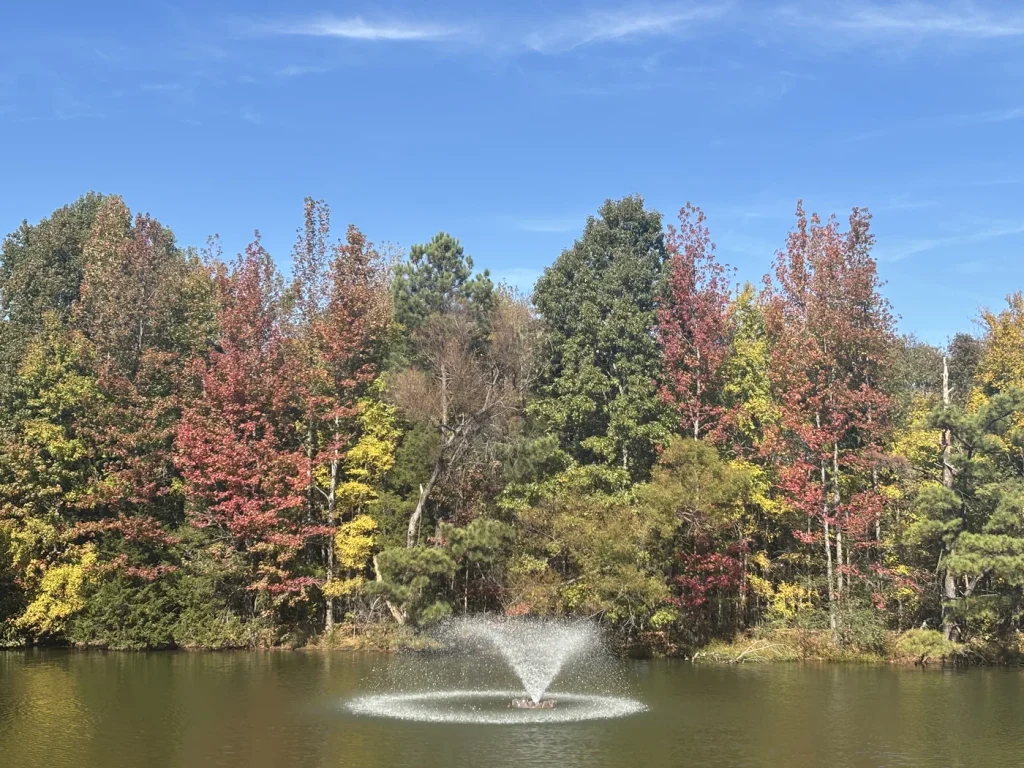
As I tarried in that moment, each detail offered a visual reminder of specific graces. As usual, these visual reminders were accented by echoes of Sacred Scripture and great literature, all of which reinforce a profound understanding. The God of Creation incessantly pours His life into my soul, through the sacraments and a life of virtue, so I can grow and flourish and benefit others.
I note first the canvas of blue sky, accented by white clouds. “The heavens are telling the glory of God; and the firmament proclaims his handiwork,” the Psalmist declares (Ps. 19:1). In art, blue is often associated with divinity, and the cloud is a common biblical image announcing the divine presence. This cements a visceral realization in my mind and heart: God is the ever-present foundation, the proverbial canvas, from which my life has been built up. Every detail, every choice I have made and good habit I have cultivated has been possible because He chose to love me into existence, and because He gave me the freedom to choose. Even when I have forgotten or rejected His presence, He still has provided moments and simple paths by which I could know and respond to Him.
Next, I notice the pond at the bottom of the scene, and the fountain in the middle. Water provides an obvious reminder of Baptism, the source and font of sacramental grace that has been so transformative in my life. When I became familiar with the Sacred Scriptures, I learned that being “born of water and the Spirit” grants access to the Kingdom of God (Jn. 3:5). I learned that Baptism corresponds to the salvation God provided to Noah and his family in ancient days, and that it purifies my sullied conscience (1 Pt. 3:20-21). I was baptized as an infant (in a non-Catholic community), but never knew of its significance until I journeyed toward the Catholic Faith. Now, every time I dip my finger into a font of holy water, I ask for a renewal of the grace of a pure, recreated soul.
A close look at the fountain indicates a breeze blowing through. This reminds me of Jesus’ words to Nicodemus: “The wind blows where it wills, and you hear the sound of it, but you do not know whence it comes or whither it goes; so it is with every one who is born of the Spirit” (Jn. 3:8). I have been the beneficiary of this same movement of the Spirit, by the Sacrament of Confirmation and by taking up the mission to which He inspires me. At times, the mission has been explicit and predictable; at other times very hazy and unpredictable.
Brown peaks through in a few places, which reminds me of the grace of humanity and the ongoing pursuit of virtue. I am a composite of body and soul; I have an intellect and a will, but I also have senses of sight, taste, smell, hearing, and touch. In the classical tradition, my intellect can grasp and assess the phenomena I approach with my senses. From there, I can use my reason and, eventually, arrive at an understanding of the natural moral law. The proclamation made by the great Christian evangelizer resounds: “For his invisible nature…has been clearly perceived…in the things that have been made” (Rom. 1:20); and the Gentiles “show that what the law requires is written on their hearts” when they “by nature do what the law requires” (Rom. 2:14-15). All this reminds me of the great grace of having potential to grow into the fullness of what He has called and equipped me to be. I pray I can live up to that potential.
Gold stands out next. On one hand, gold in art connotes divinity and the honor due to God, an idea revealed in several passages of both Old and New Testaments. At the same time, gold connotes purification and refinement. The prophet Zechariah writes about one-third of God’s people—the faithful remnant—who will be tested by fire “as gold is tested” (Zech. 13:9). This understanding translates to the New Testament, as St. Peter encourages Christians to rejoice through trials that have “tested the genuineness of your faith—more precious than gold which though perishable is tested by fire…” (1 Pt. 1:7). Thus, the gold of autumn connotes faith, the theological virtue by which I can enter into worship and relationship with God, whom I cannot fully know or comprehend. It takes up where my reason falls short. Thus, faith is a key virtue for sustaining me through the difficult purifications that occur throughout life because I know the One to whom I relate.
Green opens up consideration of the virtue of hope. I read in the letter to the Hebrews that hope is the “sure and steadfast anchor of the soul” (Heb. 6:19). St. Paul writes that hope allows me to be “patient in tribulation,” and to rejoice (Rom. 12:12). It is no coincidence that there is an abundance of green in this scene. It reminds me that the Lord, His word, and the good people He has provided to me serve as an anchor for my soul when life’s storms might have otherwise unmoored me and sent me into the abyss.
The red in the scene signals the final theological virtue, charity. I am reminded of so many New Testament passages: Jesus’ own words about laying down His life for His friends (see Jn. 15:12); St. Paul’s exhortation to the Ephesians to imitate the self-effacing love of Jesus (Eph. 5:2); his teaching to the Corinthians about the perfect way of charity being the form and guide of all other virtues (1 Cor. 13:1-7). This color means all that, but more. The particular shade of red in this scene is my wife’s favorite color. In this moment, I receive a real reminder of the sacred, sacramental love we share and impart to each other. I am called and equipped to make a charitable gift of myself in so many other ways because I make an extra effort to make a gift of myself to her. I know she does the same for me.
Finally, the whole scene—and the season of autumn, generally—provides a memento mori moment. Winter is coming, and I must remember that I will shuffle off this mortal coil at some point. Shakespeare’s words in Sonnet 73 reverberate in my mind:
That time of year thou mayst in me behold
When yellow leaves, or none, or few do hang…
This thou perceiv’st, which makes thy love more strong.
To love that well which thou must leave ere long.
Shakespeare’s point is to remind his reader, to remind me, that impending death (even if I do not know when it will happen) offers an opportunity to live and love more fully with the time I am gifted by God.
Autumn, thus, is a graced season that provides pleasant, colorful reminders of how to live and love more fully. My hope is that readers will be gifted with similar reminders, and that all our eyes, minds, and hearts will be transformed with their frequent repetition. That way, we all might, in turn, provide something beautiful to the world.
Image from Wikimedia Commons

