
[We must] rebuild the first society. The family is the first city; strong marriages and prayerful homes form tomorrow’s citizens before any vote is cast. – Dr. Scott Hahn
The Napa Institute recently held its 16th Annual Summer Conference in California. Once again, it was an extraordinary gathering filled with exceptional speakers, thought-provoking panels, and lively discussions with faithful Catholics from across the country. This year’s theme, “A More Perfect Union: Renewing Our Faith to Renew the Nation in America 250,” could not have been more timely.
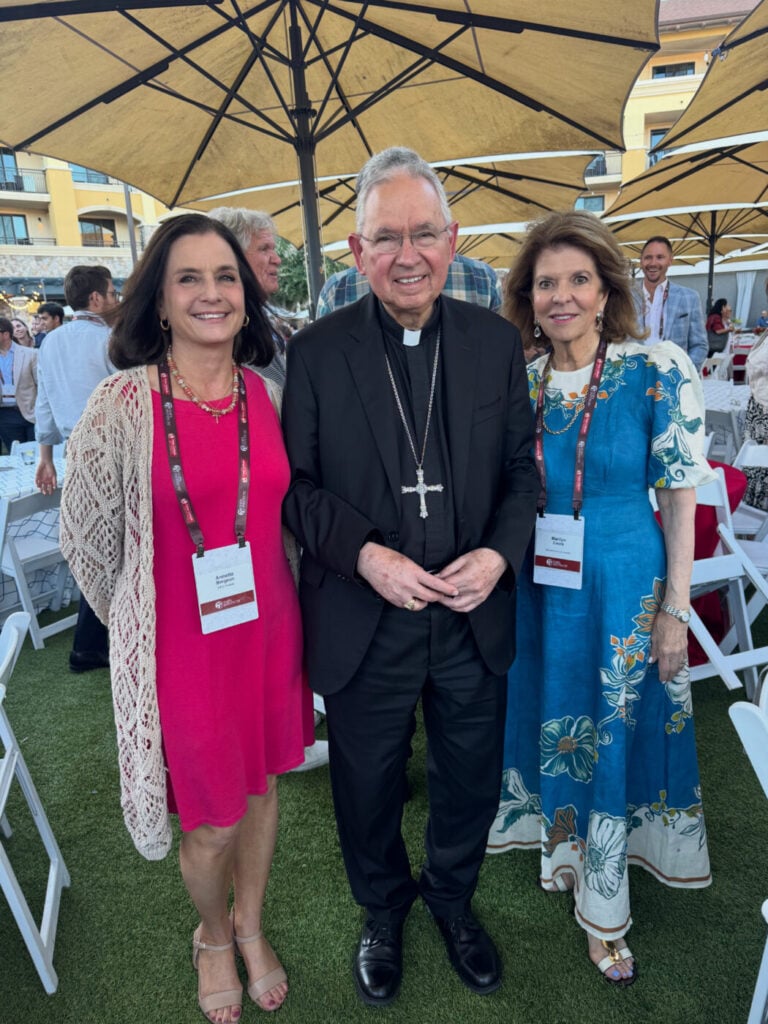
As I listened to presentations, panels, and conversations about the many challenges facing our nation, I was struck by how often the proposed solutions pointed back to the same place: strong families and thriving small group communities. Whether the topic was politics, religious liberty, education, economics, technology, or evangelization, the path forward invariably led back to the home.
The renewal of our culture will not begin with better policies or more persuasive arguments alone. It will begin in families, friendships, and the small communities where virtue is cultivated, truth is lived, and faith is handed on from one generation to the next.
Throughout the conference, I found myself reflecting on one truth in particular: how essential the feminine genius is to the flourishing of both the family and society.
In his opening welcome, Napa Institute Founder Tim Busch spoke passionately about the indispensable role of the laity in renewing the Church. “The Church needs the help of the people,” he said. I immediately smiled, recalling Pope St. John Paul II’s observation: “Woman has a genius all her own, which is vitally essential to both society and the Church” (“Angelus Address,” July 23, 1995).
Internally, I offered a small amendment to Mr. Busch’s comment: The Church needs the help of the women.
Not because women are more important than men, but because women possess a unique capacity to welcome, nurture, and form the human person. Pope St. John Paul II described this gift as the feminine genius, a particular sensitivity to the dignity of every person and an instinct to place relationships before efficiency, people before projects, and love before power. These gifts are not simply helpful to the Church. They are indispensable to her flourishing.
One of the highlights of the conference was author and theologian Dr. Scott Hahn’s keynote, “A Tale of Two Cities: Augustine, the City of God and the City of Man.” Drawing upon St. Augustine’s vision, Dr. Hahn reminded us that every civilization is ultimately built upon the loves that shape its people.
Among his seven practical applications was one that has remained with me ever since: “We must rebuild the first society.”
The first society is the family.
Before there are citizens, there are sons and daughters. Before there are voters, there are children learning what is true, good, and beautiful from the people who love them most. Dr. Hahn commented, “Strong marriages and prayerful homes form tomorrow’s citizens long before any vote is cast.
He also issued a sobering challenge: we must “…hand on the actual content of the faith deliberately, or a screen will form your child instead.” What a profound observation for this moment in history.
Every day, countless voices compete for the hearts and minds of our children. Social media, entertainment, artificial intelligence, and an endless stream of digital content all bombard their senses. Yet none can answer the deepest questions of the human heart: Why do I exist? and For what purpose?
Author and social scientist Dr. Arthur Brooks emphasized the importance of these foundational questions in his talk, entitled “The Meaning of your Life: Finding Purpose in an Age of Emptiness.” Those answers are found only in relationship, with our families, with our intimate friends, and ultimately in relationship with Jesus Christ and the truth about the human person entrusted to His Church.
Later in the conference, Princeton professor Dr. Robert George echoed the importance of the family from a different perspective. He reminded us that healthy societies depend upon healthy families because the family is the primary place where character, responsibility, and virtue are formed. Dr. George emphasized that government should not do things for its citizens that they can do for themselves and warned that unlimited government always usurps the rights of families.
As I reflected on his remarks, I found myself asking a simple question: Who will stand in defense of the family when those rights and responsibilities are threatened?
The answer came almost immediately: the moms. History repeatedly demonstrates that mothers are among the first to recognize threats to their children and among the first to respond with courage.
Whether protecting the innocence of young children, defending parental rights, accompanying struggling teenagers, or caring for aging parents, women quietly carry responsibilities that may often go unnoticed but profoundly shape the future of our culture.
This is precisely why Pope St. John Paul II believed the feminine genius is so urgently needed today.
Women see persons before they see problems. They create homes where faith is lived rather than merely discussed. They build friendships that sustain families through seasons of joy and suffering. They gather people into authentic communities where truth can be encountered with both conviction and compassion.
That work may not generate headlines, but it forms the foundation upon which every healthy culture depends.
This is also why the Church needs communities where women can be formed in faith, friendship, and authentic discipleship. Within these small communities, women encourage one another to become better wives, mothers, daughters, sisters, friends, and disciples. Together they confront many of the defining challenges of our time, including the crisis of identity, the epidemic of loneliness, the dehumanizing influence of artificial intelligence, and humanity’s enduring search for meaning. They leave strengthened not only to live their faith more deeply, but also to bring that faith into their homes, workplaces, parishes, and communities.
That is how culture changes. Not all at once, but one family, one friendship, one small group at a time.
My five days in Napa only deepened my conviction that the renewal of our nation begins not in Washington but in living rooms and parish halls. It begins in homes where parents pray with their children. It begins in small group communities where authentic friendship can flourish. It begins when women encounter the truth of who God created them to be and then carry that truth into every sphere of influence God has entrusted to them.
That is how culture changes. Not all at once, but one family, one friendship, and one community at a time.
One Practical Example
For more than twenty years, Endow has supported this work by forming women through small groups that encounter the timeless wisdom of the Catholic Church. In living rooms, parish halls, coffee shops, and online communities around the world, women gather to study the teachings of the Church and the writings of the saints. They also discover something our increasingly isolated culture desperately needs: authentic friendship.
These communities help women grow as disciples and in service to their families, parishes, workplaces, and neighborhoods. Whatever form renewal takes in our culture, it will require these grassroots, family-based relationships and communities where the human person is formed for social interaction.
If we hope to rebuild the first society, we would do well to invest more in them.
Author’s Note: Endow is a global Catholic apostolate that calls women together to deepen their faith through exploring the timeless wisdom of the Church. Letter to Women, Endow’s most popular and foundational study, uncovers profound reflections on human dignity and reveals timeless truths, helping women rediscover the beauty and the power of their feminine genius. To learn more about Endow, including how to start an Endow group in your home, parish or online, visit endowgroups.org.
Photo by Ilya Pavlov on Unsplash

