
Every year, on November 22nd, hundreds of pilgrims gather at the Basilica of Santa Cecilia in Trastevere for the feast of the patron saint of music, St. Cecilia. While the basilica—especially the crypt containing the remnants of the saint’s home—is worth a visit year-round, it truly comes alive on her feast day.
One thing that will draw the eyes of pilgrims is a most remarkable statue of St. Cecilia underneath the high altar. Carved in white marble, Stefano Maderno’s masterpiece depicts St. Cecilia’s death in a dramatic and moving fashion. The statue is a stunning triumph of devotion and Baroque art, and I have spent many minutes in the basilica studying it.
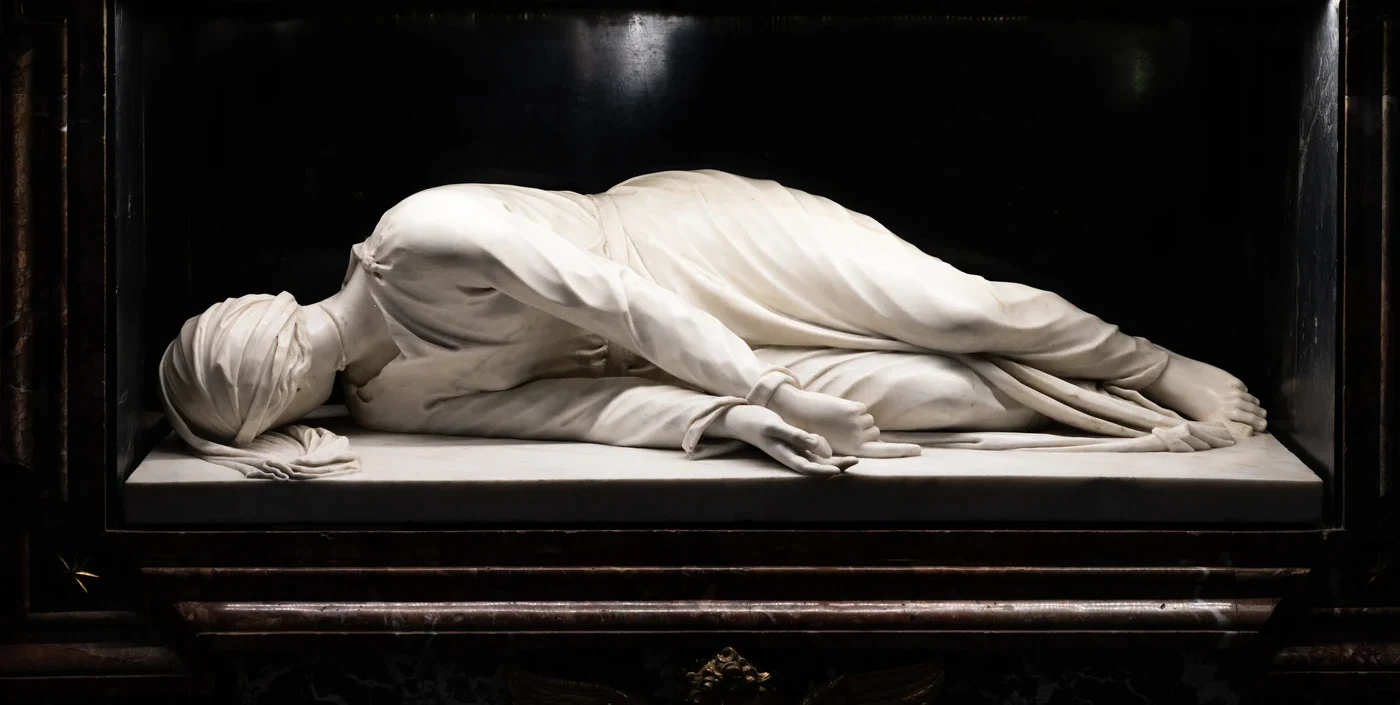
Many pilgrims may not know that, unlike other artists, Maderno sculpted his masterpiece based on the incorrupt relics of the early Christian saint.
A Life of St. Cecilia
The life of St. Cecilia has inspired artistic giants from Chaucer to Dante Gabriel Rossetti, but her story bears repeating here. Tradition tells us that Cecilia was a noble citizen of Rome in the third century who converted to Christianity before making a private vow of celibacy. Unfortunately, her parents had already betrothed her to the nobleman Valerian.
On the day of her wedding, Cecilia sang praises to God within her heart, which is among the reasons she is the patron saint of music and musicians. When the time came to consummate her marriage, Cecilia told Valerian of her vow. Some sources say she was guarded by an angel, whom Valerian would see after he accepted baptism. Either way, her husband accepted her faith and vow of celibacy, and eventually Valerian’s brother, Tiburtius, also accepted the Christian Faith.
As this was a time of persecution in Rome, Cecilia’s husband and brother-in-law were beheaded under orders of the local prefect. Their guard, Maximus, was also martyred, having accepted Christianity through the witness of Valerian.
The prefect ordered Cecilia to be killed too, but her death was not as public, as he feared a public backlash due to Cecilia’s popularity. She was first locked in her calidarium, a sort of Roman steam room, to be asphyxiated. She survived and was then ordered to be decapitated.
Despite the three blows to her neck by a sword, Cecilia survived for three days, dying slowly as she proclaimed the greatness of the Lord. She also made arrangements with Pope St. Urban for her burial, requesting that all her possessions be given to the Church and the poor. She was buried by the pope in the Catacombs of Callixtus, and her home was converted into a church.
Rediscovering the Saint
Almost immediately after her martyrdom, St. Cecilia became a popular saint, and the church built over her home was (and remains) a necessary stop for pilgrims going to Rome. Pope St. Gregory the Great declared Santa Cecilia a basilica, and the church was later rebuilt and expanded by Pope St. Paschal in the ninth century.
Pope St. Paschal also moved the relics of St. Cecilia to the basilica in Trastevere after he had a dream in which she showed him where to find her relics in the catacombs. The pope had a great devotion to the saint, invoking her as “The Virgin Cecilia who always carried the gospel of Christ on her breast.” With her remains moved to the basilica, more and more pilgrims made the sacred space a priority for their journey.
In 1599, ahead of the great Jubilee of 1600, the Cardinal-Priest of Santa Cecilia, Paolo Emilio Sfondrati, began extensive renovations of the basilica. His work included hiring a celebrated archaeologist to restore the crypt and find the remains of St. Cecilia, along with Saints Valerian and Tiburtius. Soon enough, three marble sarcophagi were discovered buried in the crypt.
St. Cecilia was buried in the smallest sarcophagus, and it was opened before Cardinal Sfondrati and other onlookers. To everyone’s amazement, after the sarcophagus was opened, St. Cecilia was found to be miraculously preserved, even after many centuries of burial. It turned out that St. Cecilia, the celebrated early Church martyr and patron, was among the most famous of the Incorruptibles—those who, without a natural explanation, are preserved from the natural decay of the grave.
Word spread quickly, and numerous people flocked to the basilica to see the incorrupt relics of St. Cecilia, including Pope Clement VIII. Already a beloved patron, St. Cecilia and the story of her incorrupt body spread throughout Christian Europe, which was undergoing the Counter-Reformation.
To capture this incredible moment, Cardinal Sfondrati hired the twenty-three-year-old artist Stefano Maderno to carve a statue based on how St. Cecilia was discovered. Modern art scholars dispute this, but sources tell us that Maderno got to carve the marble sculpture based on his own witnessing of St. Cecilia’s remains. He was likely also influenced by testimony and his knowledge of older Roman statues depicting death.
St. Cecilia: A Patron for All Artists
Maderno’s statue can still be admired inside Santa Cecilia in Trastevere, and I love seeing this church and statue when I get to Rome. A few times, I’ve also been lucky to be in the basilica when one of the nuns is practicing the organ, which sets the perfect mood for contemplating the patron saint of music.
As we see with Maderno’s moving sculpture, St. Cecilia inspires artists of diverse mediums. We may remember her as the patron saint of music, even naming our parish choir after her, but she inspires poets, sculptors, painters, and so many more. It makes sense, in a way, because, as Christian artists, we know that our work always goes back to singing the praises of the Creator.
As we approach her feast day this weekend, call upon St. Cecilia to help you to sing a song of praise to God in your heart. You can also ask her for help in your own artistic medium, asking that your work will move others to praise and contemplation.
Santa Cecilia, ora pro nobis!
Image from Wikimedia Commons

