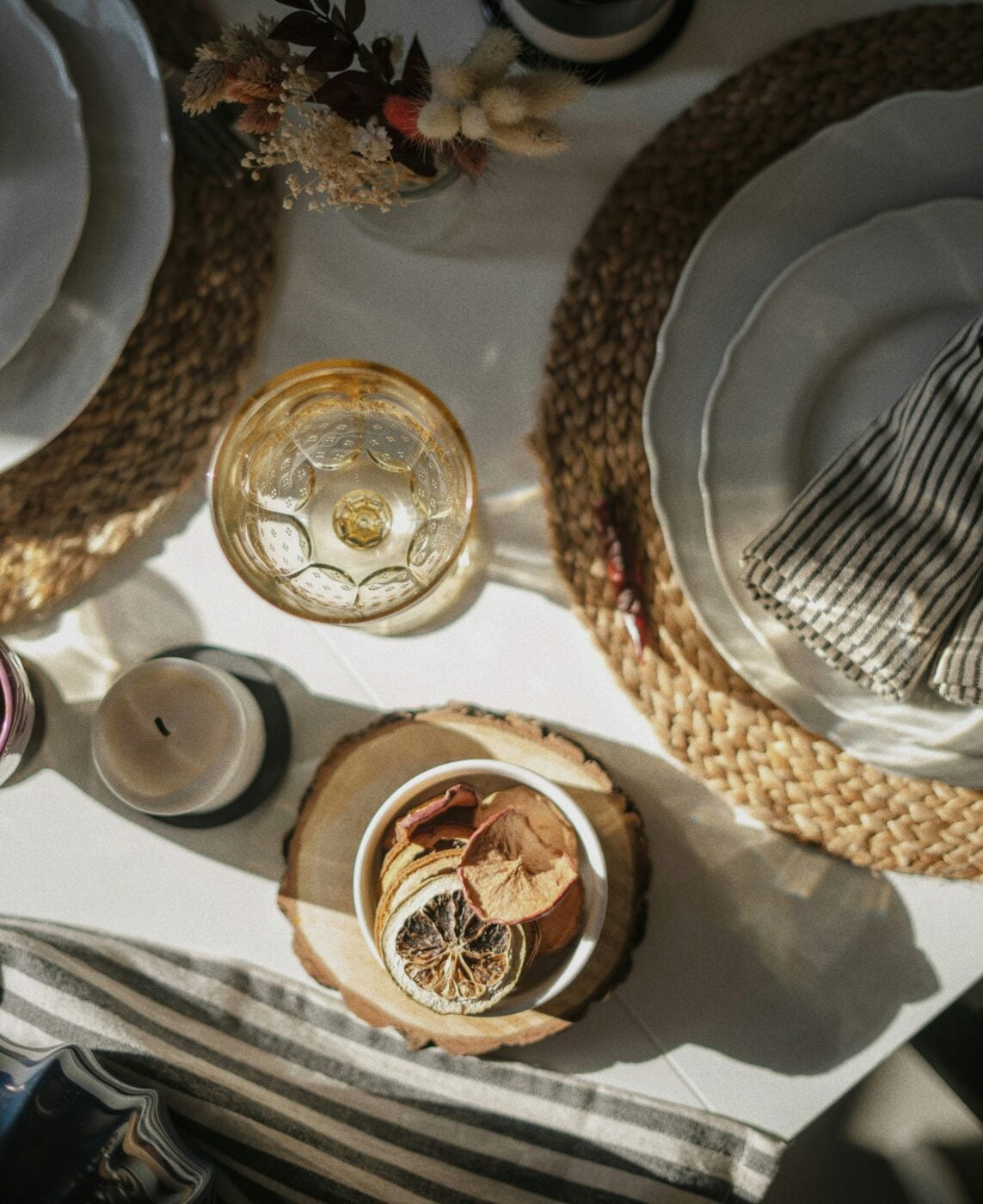
Just out of curiosity, Margherita once counted the number of times she had set and cleared the family table since her wedding day; it was nearly fourteen thousand times. She grew up in Reggio Emilia, Italy, where the family meal was simply assumed. A tavola—at the table—was a given. Marcie, on the other hand, grew up in a culture where the family always had a daily rhythm, but she never liked to cook. While we both came to the table from different directions, we arrived at the same conviction: the table matters, and it is worth fighting for.
“What you permit, you promote” a friend of ours, father of 6, warned. Too often we let habits, like sharing meals, be forgotten due to ever-growing obstacles and distractions. So, here we have decided to go over the most common ones and share the simple ways we have seen families overcome them.
1. The Pressure to Appear Perfect
Many of us stall on hosting meals due to what we think has to be changed in our homes first: a bigger dining room, calmer children, a finished basement, a less complicated schedule, a fancy menu.
Our friend Mary loved hospitality, but for years the planning held her back. “The mental load of coordinating held me back from doing anything,” she told us. Then, one summer, she and her husband, Evan, made a simple proposal: every Wednesday evening, their home would be open. Whoever wanted to come could come, with or without a side dish.
Eleven Wednesdays followed. There was horchata and a huge pot of Belizean rice and beans. Children ran through the yard. Conversations stretched late, and every evening ended in prayer. Over time, people started sharing their personal intentions during that common prayer time.
Nothing about their circumstances or their house had changed. They just chose to stop waiting for everything to be “perfect.” Mary realized a deep truth: “People weren’t looking for the perfect house. They were looking for relationships, for belonging.”
2. The Work of Making a Meal
For many mothers, the obstacle is the work itself, which never seems to end, and the feeling of inadequacy that sometimes accompanies it. Marcie, with 7 kids homeschooled for more than 20 years, knows this feeling well. The constant effort of planning and preparing, and the ease with which the habit slips away as family life changes, can make the family meal feel like one more thing to fail at.
However, a simple bowl of pasta, a pot of soup, bread and cheese—these are enough. It is not about perfection; it is about the gathering. Nor does all the work have to belong to one person! Children can set the table, pour the water, fold the napkins, and clear the plates. The meal becomes more and more like a school, a school of love.
3. Screens, Screens, and More Screens
Technology, unfortunately, is no help here. It is possible to sit at the same table and yet not be present to one another at all. Phones in hand, the television constantly on in the background, the habit of checking “just one more thing” all pull us away from one another. In his bestseller The Anxious Generation, Jonathan Haidt states: “Shared meals should be phone-free so that family members attend to each other.” Of course, this is easier said than done, but with small steps the trend can be reversed.
Beyond setting the “no screens at dinner” rule, a small, physical sign can help mark the meal as a different time. In both of our homes, this begins with a cloth. For Margherita, the tablecloths came with her from Italy—a boxful of cotton ones and linen ones and a special one, hand-embroidered in Madagascar, that friends brought her as a wedding gift. Marcie received her first tablecloth from an Italian foreign exchange student. Marcie was ready to fold it away in a drawer to save for Christmas, but the young student had a different idea: “We can use it tonight!” They did, and from that evening on, Marcie’s table has never been without a cloth.
The signal of laying a tablecloth, even one with some stains on it, tells everyone who walks by that something is about to happen. Phones stay in another room or on the counter (the farther the better!), and the television stays off. It is a modest boundary, but it teaches children, teenagers, and adults alike that the people at the table come first.
4. Busy Schedules That Don’t Align
Our overbooked family calendar is, without doubt, a great obstacle to our shared meals. Practices, late shifts, homework, commutes…some evenings, a full family dinner is impossible. However, creativity and sometimes choosing to say “no” come to our aid. A 4PM dinner before a two-hour sports marathon, or a 9PM dinner with only the older kids can still create a special moment of bonding. A long Sunday lunch or a bi-weekly family dinner can be an anchor when weeknight schedules are scattered.
Perhaps our biggest word of advice is to include prayer at mealtimes. A woman named Jane once approached Margherita after a talk and said that for years she had fed her children and their friends around the table, every night, and that they always said a prayer together. Some of the friends didn’t know the prayer, so one evening her daughter printed it out. The family began handing the card to every guest.
Years later, those children went off to college and started families of their own. They took the prayer card with them. They sat at new tables, with new families, and said the prayer when they ate together. Such a simple act—printing a prayer card—invited these guests to form a habit of prayer, giving thanks to God and asking Him to be present at their table.
Sharing the Banquet
Remember: the goal should be faithfulness, not a perfect record. None of the families we know, our own included, would call themselves experts. Their tables are small and large, loud and calm, set with care or set in a hurry. There are tantrums and raised voices, and there is forgiveness and the slow work of learning to listen. Sometimes, there is simply silence.
What they all seem to understand is that we come to the table hungry and in need of what we cannot give ourselves. The table is an ordinary place where we show our love and acknowledge our dependence on one another, where the hunger of one person is met by the presence of another.
Dorothy Day said it best: “We know Him in the breaking of bread, and we know each other in the breaking of bread, and we are not alone anymore. Heaven is a banquet, and life is a banquet, too, even with a crust, where there is companionship.”
Tonight there is a table waiting in every home. Let’s use it.
Author’s Note: Marcie Stokman and Margherita Vezzani are the authors of A Cloth Upon the Table: The Quiet Revolution of Eating Together (Sophia Institute Press). Through the stories of twelve families across Minnesota, Ohio, New York, and Indiana, and the photography of Margaret Nelson, the book offers honest reflection and practical guidance for reclaiming the family table as a place of communion, hospitality, and faith. It is not a cookbook. It is an invitation back to the table.
Photo by Stefan Vladimirov on Unsplash