
Fr. Drew,
You heard my confession so kindly on March 5th. I drove to Missouri with a longing in my heart to go to church, and when I found you, it was like a miracle happened. Thank you for dropping what you were doing to hear me. I will always remember it. Please pray for me, Father. I started praying for you.
P.S. Your church is beautiful.
Now that, my friends, is what you call a good letter. Some “fun mail” amidst the stack of bills and advertisements. I share it with you to make a few points: Outside of her name, which the woman included in her letter, I have no idea she is. If she walked in here today, I would not recognize her. In truth I only have a vague memory of her stopping by. And that is only because she sent me a note. Otherwise, I would have forgotten. It was just another day in my life. Most importantly, I have no idea what she confessed.
Last Sunday I preached about the psychology of confession. Citing Bishop Sheen, I preached how confession only works when you, the penitent, confess your own sins. “Let me tell it,” you need to say. But you have to confess to someone else, not to yourself. You have to confess to an agent, a representative of the higher standard. Christ told those representatives the day He rose from the dead: “Whose sins you forgive are forgiven…”
But what is the heresy that people spout today? They say, “I just go straight to God. I don’t need to confess my sins to another sinner.” Really? Were the then-eleven Apostles sinners or saints on Easter Sunday when Christ told them to forgive or retain sins? They were, of course, sinners. How then can people say they don’t confess to sinners when Christ set things up that way? Did Christ set things up wrong?
Another heretical claim made is that confession was instituted not by Christ, but by priests. Really? Would priests invent confession? Priests have to sit in a stuffy box for extended periods of time and listen to bad behavior. Priests themselves, including the pope in Rome, have to go to confession. If priests invented it, wouldn’t they have exempted themselves from going? If the pope has to go, then you should too. Go to confession!
“Pray morning and evening prayer and go to confession.” That is how a priest once inaugurated spiritual direction for a new student. He told him: “It is good to have Iron Age prayers in your mouth every day…and regular confession will show you how to live with charity.”
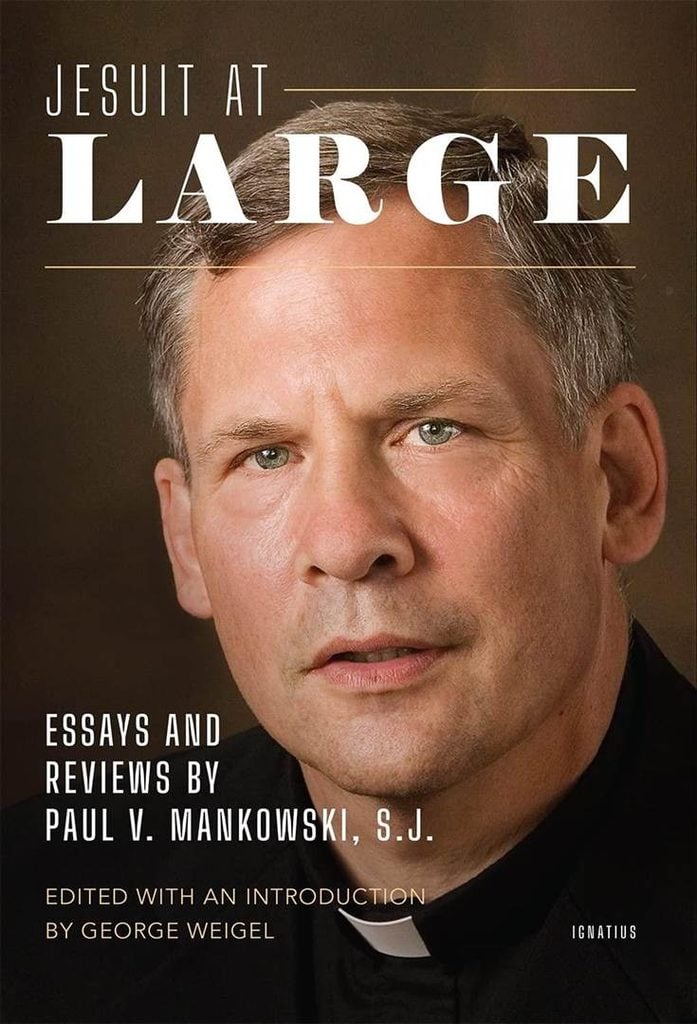
The priest who said that died suddenly six years ago this month, at age 66. His name was Paul Mankowski from the Chicago area.
He didn’t look like your typical, modern-day priest; he looked more like a linebacker for the Chicago Bears and was once, in fact, a boxer. He also worked in a steel mill to pay for college. No wonder he was fond of “Iron Age prayers.”
So, was Fr. Mankowski stationed at some blue-collar Polish parish on the south side of Chicago? No, he entered the Jesuits, earned a doctorate at Harvard in ancient languages, and taught in Rome for years. Highly regarded as one of the finest Catholic essayists of his time, Mankowski was not only brilliant, but some also argue he was saintly. He owned very little and wore beat-up clerical clothing and shoes. Most of us have never heard of him, though we should have.
He came to my mind last week as I preached about the higher standard, the one outside and above ourselves. In 1993, Fr. Mankowski wrote about the higher standard in his essay, The Prayer of Lady Macbeth: How the Contraceptive Mentality has Neutered Religious Life. Mankowski wrote how the Pill changed everything:
To contracept by this method involved not a surrender to the urgent passions of an instant but an action—better, a series of actions—clearly foreseen and assented to in cold blood, passionlessly, with deliberation and resolve.
He went on:
Contraception involves no temptation at all in the sense of pressure to yield to an impulse (Was Lady Macbeth tempted to murder Duncan?) but rather the resolution to lead one’s life in defiance of the Church. To contracept while attempting to remain a Catholic accordingly required the development of an entirely novel religious stance, a stance founded on two beliefs: first, the conviction that the teaching Church is wrong in an area in which she explicitly claims authority; and second, the conviction that a Catholic can coherently hold that the Church is wrong in one place and right (or right enough) in others such that Church membership remains a conscientious and meaningful choice.
Do you see what the “entirely novel religious stance” did to us? Mankowski wrote that it involves the belief that there is a higher or deeper or more reliable mediator of God’s will than the teaching Church. If the Church is wrong, it can only be wrong in reference to some standard outside of the Church. What then is that standard?
Whatever that standard is—moral intuition, a better reading of Scripture, or a new system of ethics or logic—there is a crucial point to understand: Whatever that standard is, it judges the Church and is not itself judged by the Church. “Here,” Mankowski wrote, “is the real revolution incited by the Pill; next to it the rise in promiscuity is a mere flutter.”
Do you understand the disaster that was unleashed on us? The authority of the Church was decimated. As a result, thousands of good and holy men and women left religious life. Thousands of others were not born. Fertility has collapsed, and we are now living below replacement level. People on TV, with straight faces, stare into the camera and declare that men can be women and women can be men. This is what happens, my friends, when we and our conscientious and meaningful choices become the higher standard.
Most have never heard of Fr. Paul Mankowski because he was silenced by his Jesuit superiors for the crime of “telling inconvenient truths.” Mankowski found information in the Jesuit archives that conclusively showed that “Fr. Robert F. Drinan had systematically and intentionally misled Pope John Paul II, with the connivance of Jesuit superiors, when he ran for a seat in Congress and served there for a decade, becoming one of the country’s most important proponents of legal abortion.”
Did you know that? A priest, a Jesuit, was an abortion-advocating congressman in Massachusetts from 1971 to 1981. He only left office after Pope John Paul II demanded he do so.
Fr. Mankowski did nothing illegal, nor did he write falsehoods. The Jesuits did not deny what he wrote, but they punished him by demanding that he no longer publish essays in his own name and that he only publish essays related to his specialty, ancient languages.
He used that slight opening to write, among other things, a “shattering takedown” of fellow Jesuit Fr. James Martin’s pro-homosexuality book Building a Bridge. A scholar noted that Chicago’s Cardinal Cupich was so enraged with Mankowski’s review that he hinted at withdrawing Mankowski’s permission to minister as a priest in Chicago, where he was living at the time.
My friends, it’s getting late in the game. The gospel passage for this week places Christ in Jerusalem for the last time, just days before He is crucified. It’s time to get in the vineyard and get to work. In the verses directly before Sunday’s passage, the interrogating Pharisees asked Christ where He got His authority. Christ turned the tables and asked, “Where do you think it comes from? From heaven or from men?” The Pharisees refused to answer Christ. Where do you think it comes from? From heaven or from men?
Photo by Grant Whitty on Unsplash

