
Then the two recounted what had taken place on the way and how he was made known to them in the breaking of bread.
The early Christians called the sacred mysteries Christ commanded them to celebrate “the breaking of the bread.” Why? Probably because they couldn’t think of anything better to call them. Bread and wine became Christ’s Body and Blood. How were they to put that into words?
Today we call it Holy Mass. Probably because we can’t think of anything better to call it. What does Mass mean, anyway? It’s from the Latin missa, which means “Go, you are dismissed.” Speaking of “going,” listen to a short, 19th century poem in which Christ tells us to “Go”…
Whenever there is silence around me
By day or by night—
I am startled by a cry.
It came down from the cross—
The first time I heard it.
I went out and searched—
And found a man in the throes of crucifixion,
And I said, “I will take you down,”
And I tried to take the nails out of his feet.
But he said, “Let them be,
For I cannot be taken down
Until every man, every woman, and every child
Come together to take me down.”
And I said, “But I cannot bear your cry.
What can I do?”
And he said, “Go about the world—
Tell everyone that you meet—
There is a man on the cross.”
– Elizabeth Cheney
The poem is both hauntingly beautiful and theologically correct. For Christ, in His Mystical Body, is still hanging. How can that be?
Christ died physically once as a man on Good Friday. But the man was and is God. And God is outside of time. Christ is the Alpha and the Omega, the beginning and the end. He died for you—and dies for you. St. Gaudentius of Brescia, a 4th century Italian bishop, wrote that Christ left us Mass as a pledge of His abiding presence:
This sacrifice is our sustenance on life’s journey; by it we are nourished and supported along the road of life until we depart from this world and make our way to the Lord.
Gaudentius wrote it was the Lord’s will that we should be “constantly sanctified according to the pattern of His own passion.”
And so he commanded those faithful disciples of his whom he made the first priests of his Church to enact these mysteries of eternal life continuously. All priests throughout the churches of the world must celebrate these mysteries until Christ comes again from heaven. Therefore let us all, priests and people alike, be faithful to this everlasting memorial of our redemption. Daily it is before our eyes as a representation of the passion of Christ.
Now, did St. Gaudentius have it wrong? Was he confused? Did so-called reformers 1000 years later, men who abandoned priest and sacrifice for the Bible and faith alone, straighten him out?
St. Peter wrote that Christ was crucified for you. And He will impartially judge each of you according to your works. That calls for a life of sacrifice and making an offering of oneself to the Lord.
With that said, there is a liturgically incorrect photograph in the back of my parish. It’s a photo I took my first day here in 2021. It features a 1970s wooden table altar with a big green plant in front of it. For most of Catholic history, the priest—and not a potted plant—would have stood in that spot.
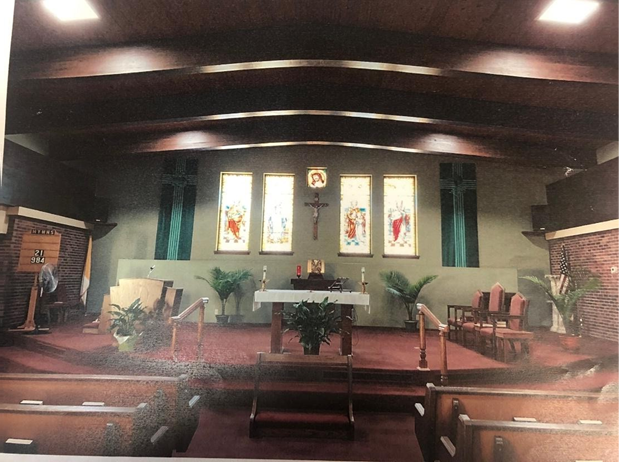
To the left of the table altar is the ambo, or lectern, where the Scripture readings and sermons take place. Notice how the altar is positioned in front of the ambo. It sits nearer the congregation than the ambo does. What’s wrong with that picture? Why is it wrong that the altar comes before the ambo?
Well, for starters, it is not how Christ arranged things. How so? you may ask. Luke records that on the road to Emmaus, Christ cited the Scriptures and then gave a sermon as to how they pertained to Him. Later, in the house, when the disciples were prepped for it, the sacred mystery happened. Christ broke the bread, they recognized it was Christ, and then Christ vanished.
So, you see, the Scripture lesson comes first, not second. It is not the end. It preps the faithful for what comes later. And it is what comes later—not faith alone nor Scripture alone—that saves us. As St. Peter taught, it is the Precious Blood of Christ, sacrificed on the altar, that saves us.
Back in 2021, I slowly and stealthily moved that table altar back an inch at a time over several months, until it was positioned behind the ambo. A few parishioners who sat closer to the front were on to me as they noticed the indentations in the rust-colored carpet. In the meantime, the potted plant, the table, and the carpet have been replaced with marble tiles that resemble a sea of glass:
…and before the throne there is as it were a sea of glass, like crystal…and day and night they never cease to sing, “Holy, holy, holy, is the Lord God Almighty, who was and is and is to come!” (cf. Rev. 4:6-8)
So wrote John in the last book of the Bible, the book that describes Mass being offered in heaven.
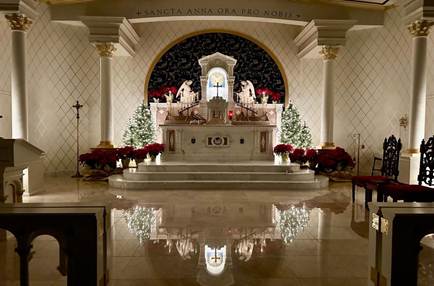
My friends, this is all a sacred mystery. So it ought to look like one. It needs to look like what it is so we believe it, so we believe the hard saying in John 6—that we have to literally eat Christ’s Body and drink His Blood—not symbols of those things, but the actual things.
Symbols of food don’t sustain anyone on a journey. A picture or cardboard cut-out of a cow doesn’t nourish anyone. No, we need the real cow. And so, the cow needs to be slaughtered. The wheat needs to be ripped off the stalk, the grape needs to be crushed in the press, and the Lamb needs to be slain. All these things get sacrificed. They die before they can be incorporated into our bodies to nourish and sustain us.
So, here we are, on our earthly sojourn, walking on our way to eternity. If we can shut out the noise pollution and find some silence, we might be able to sense Christ walking along with us. Does He shout and bark commands? No, He simply asks, “What are you discussing as you walk?” Then He gently probes: “What sort of things are people saying about me?” After our answer, He gives the impression that He is going further on without us. But we urge Him, “No! Stay with us!”
Christ gives the impression He is moving on because He wants it to be our idea that He stays. He wants it to be our idea that we make ourselves present for His eternal sacrifice, once known as the Breaking of the Bread, and now as Holy Mass, the everlasting memorial of our redemption and re-presentation of the passion of Christ; the sacred mystery that requires two deaths: Christ in His Mystical Body and our death to sin.
Going forward, until we depart from this world and make our way to the Lord, let us offer ourselves to Him who died and dies to save us. Let us prepare ourselves and offer the highest worship there is—sacrifice. And then, when Holy Mass is finished, I will dismiss you and tell you to go forth. From there you can go out to the world and tell everyone you meet: There is a man on the cross.
Photo by Christian Harb on Unsplash

