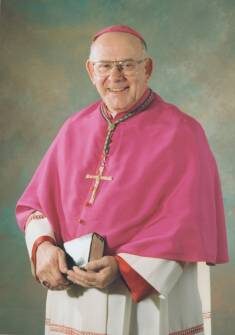
The following homily was given by Arlington Bishop Paul S. Loverde at the Cathedral of St. Thomas More in Arlington, Virginia, on June 30, the 13th Sunday in Ordinary Time.
Once there was a family on the brink of poverty and starvation, but full of love for God and one another. One day a man dressed in rags appeared at their door begging for food. The husband opened their house to the tattered-looking stranger, gave him a portion of their meager food and a portion of their family’s great love. As the man thanked the family for their hospitality, he was transformed before their eyes, and they realized that they had, in fact, offered their charity to Jesus, Who had come to visit them in disguise. This story, which many of us have heard before, illustrates the truth in today’s readings. As individuals, as families and as the Body of Christ, the Church, we are called to be welcoming to everyone we meet. Every human person is made in the image and likeness of God; they are our brothers and sisters in the human family, and if they are baptized, then they, like us, have God’s life dwelling in them and are a part of the same Body of Christ. There are two important lessons for us this morning: first, that as followers of Jesus Christ, we have a Gospel responsibility to be welcoming to everyone we meet and to responding to their needs, if we can, and, second, that God often sends us blessings in disguise.
As Christians, we are called to welcome our brothers and sisters, and do all that we can to alleviate their needs and sufferings. Our Holy Father tells us: “In following the Master's example, the Church too lives as he did in the world with the attitude of a pilgrim, working to create communion, a welcoming home where the dignity conferred by the Creator is recognized in each human being” (Message for the 85th World Migration Day 1999, 1). Our Scripture readings give us concrete examples of how we are to carry out this Gospel responsibility.
Our first reading describes how a married couple extended hospitality to Elisha, a prophet of God. They began their efforts to help meet his needs in a small way by offering him dinner, but increased their hospitality, as their understanding of his needs became more clear to them, by arranging a room for Elisha to live in when he was visiting their town. Our Gospel deepens this lesson by telling us, “Whoever receives a prophet because he is a prophet will receive a prophet’s reward, and whoever receives a righteous man because he is righteous will receive a righteous man’s reward.”
Many times we make excuses for not carrying out this Gospel responsibility. We are too busy, or too rich, or too poor, or it would not be “prudent” or “realistic.” We can find many reasons not to open our lives to the needs of our brothers and sisters, but we must remember the injunction given to us by our Lord in today’s Gospel: “Whoever loves father or mother more than me is not worthy of me, and whoever loves son or daughter more than me is not worthy of me. Whoever finds his life will lose it, and whoever loses his life for my sake will find it.” We need to prayerfully consider how we as individuals, as families and as a Church can welcome the stranger, the immigrant, the newcomer and the sinner. We must prayerfully consider how we can take concrete steps to encourage the downtrodden, listen to the lonely, support the suffering, alleviate poverty and provide an environment where each human person is welcomed and celebrated from conception through every stage of life until natural death.
A second lesson for us this morning is an important one in the Christian spiritual life. Many times God sends us blessings in very unlikely packages. Consider the married couple in our first reading. A man came to their town and they were impressed by his love for God, so they invited him to dinner whenever he would visit. They made sacrifices in their schedules and financial wellbeing not only to feed him, but eventually also arranged a guestroom for him in their house. Unbeknownst to them, God blessed them with something they surely had longed for: a child. God often gives blessings as a reward for unselfish behavior that benefits His children, and the child God gave to this barren married couple was a reward for their charitable outreach. They did not let their desire for a child consume them, and they did not totally focus on their own schedules, wants or needs, but they faithfully fulfilled their covenant duty of charity and ended up being blessed for it. “Whoever finds his life will lose it, and whoever loses his life for my sake will find it.”
When we give our lives to God, He blesses us in ways beyond our imagining. St. Paul reminds us: “If, then, we have died with Christ, we believe that we shall also live with him.” We must die to ourselves, our schedules, our will, our plans, and allow God to reveal Himself to us His schedule, His will and His plan for our life. This is a life-long process, but the person who begins this transformation sings with our psalmist: “The promises of the Lord I will sing forever, through all generations my mouth shall proclaim your faithfulness. For you have said, ‘My kindness is established forever’; in heaven you have confirmed your faithfulness.”
God is faithful! When we allow God to transform us through His grace that we received at baptism, allow it to grow through our regular prayer life which includes personal prayer, liturgical prayer and a dynamic sacramental life, and express this transformed life in concrete acts of charitable outreach, we are enabled, in ever new ways, to receive the blessings of God.
Today, we are called by our Scripture readings to imitate and welcome Jesus Christ by opening the doors of our hearts to those around us who are in need. The people we encounter will each be different and have various needs, but we are called to extend to everyone the gifts and love God has given and entrusted to each us. The cost of fulfilling this Gospel responsibility is sometimes high, but, then again, so are the rewards. Today, let us recommit ourselves to this Gospel responsibility of welcoming others and caring for others. Let us never forget that what we do to the least of our brothers or sisters, we do for God Himself. And may God bless us as individuals, as families and as the Body of Christ so that the words of Jesus may be found true in our lives: “Amen, I say to you, [the one who gives to others for God’s sake] will surely not lose his reward.” Amen.
(This article courtesy of the Arlington Catholic Herald.)